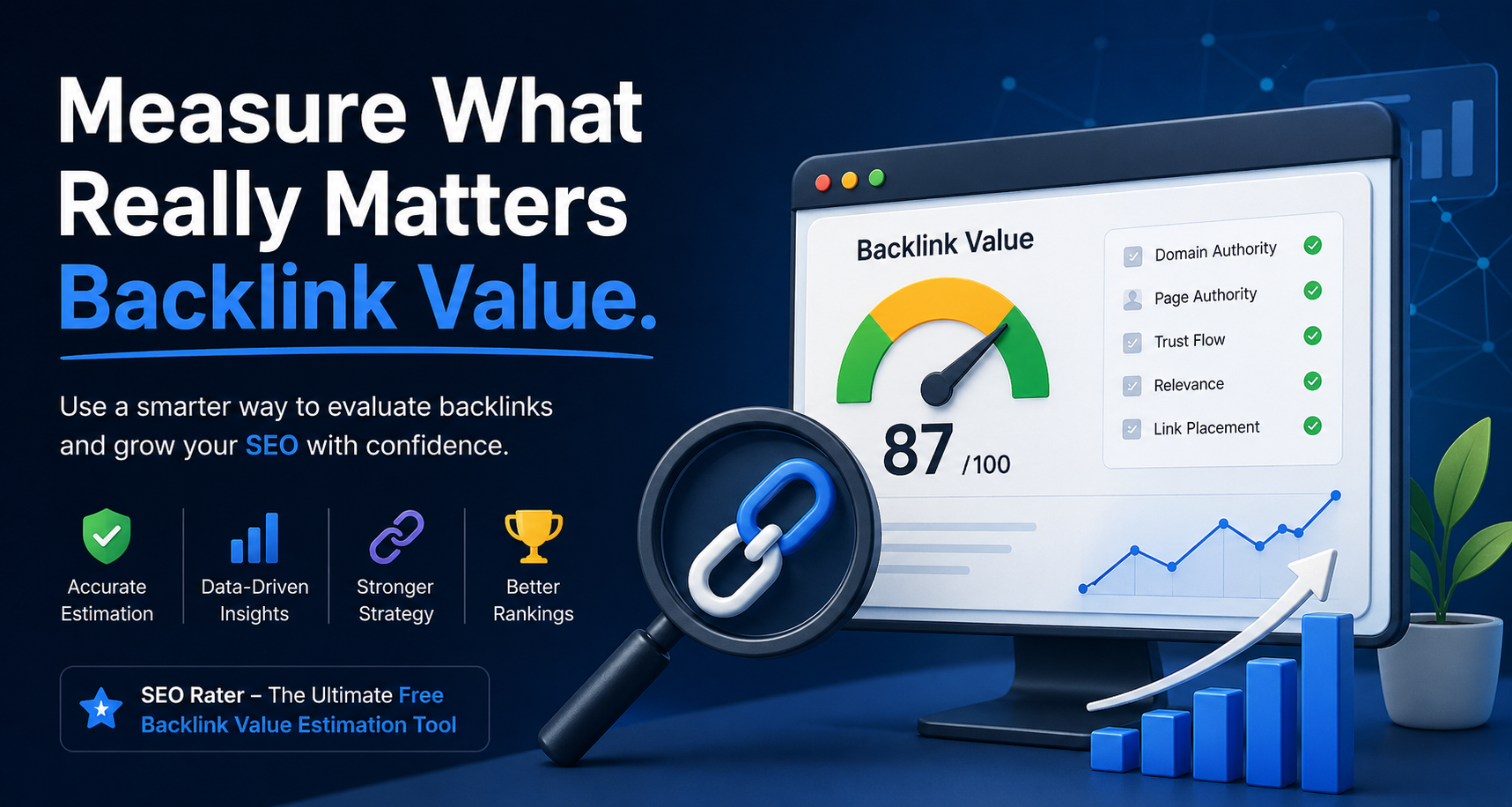
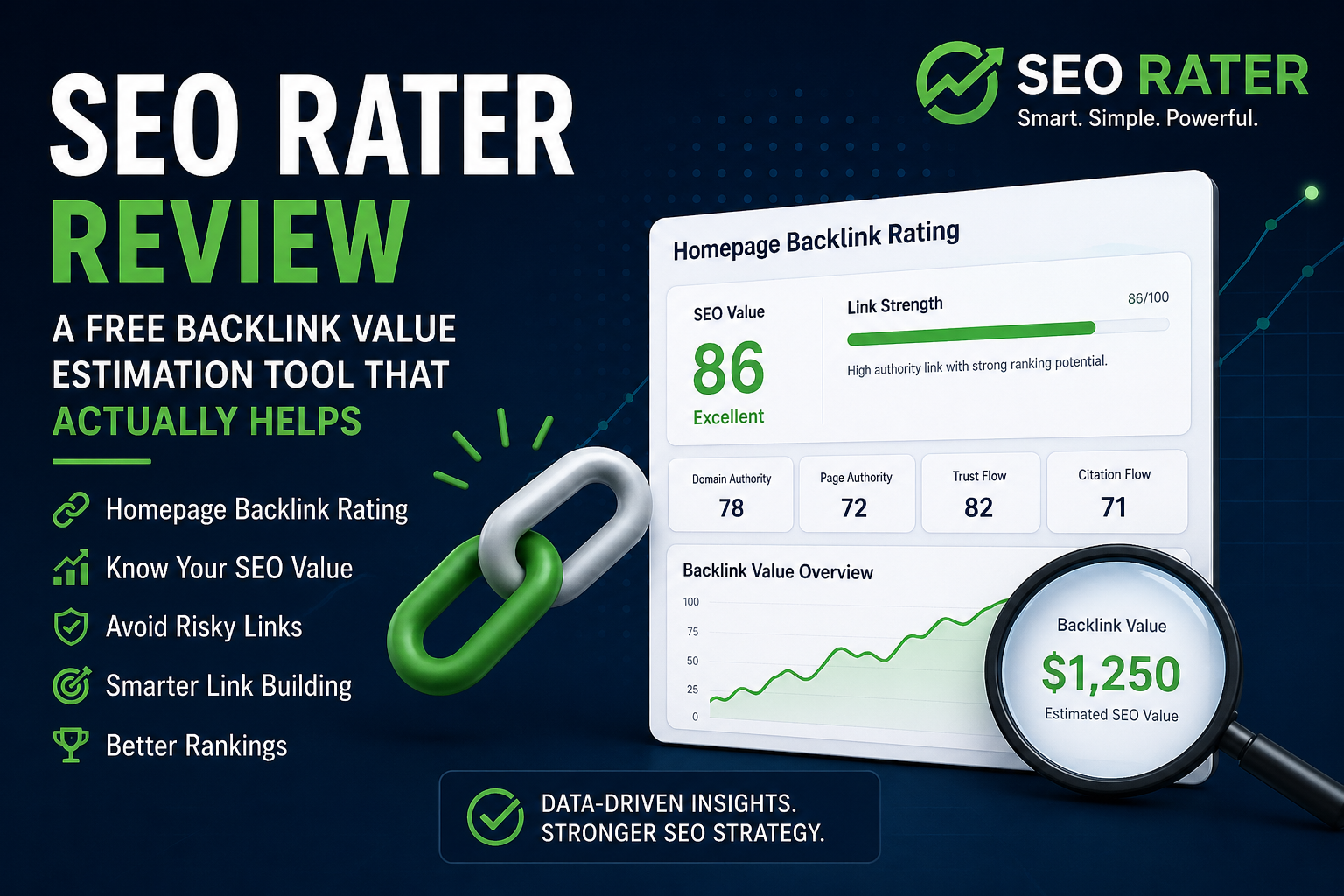
SEO tools are everywhere, and honestly, most of them start to feel the same after a while. Big dashboards, endless metrics, and a lot of numbers that look impressive but don’t always help you make a real decision. That’s why SEO Rater is interesting—it doesn’t try to be everything. It focuses on one thing: estimating backlink value in a way that’s actually usable in day-to-day SEO work. 🤔
At the center of its approach is a simple idea: not every backlink is equal, and most people waste time treating them like they are. Instead of dumping raw data on you, the platform tries to translate SEO signals into something more direct—how valuable a link might actually be in practice.
One of the first places you naturally end up exploring is the Website Rating Tool, which is basically the core system for how pages and backlinks get evaluated. It doesn’t feel overly technical or overwhelming, which is already a plus if you’ve ever used SEO tools that require a learning curve just to understand the dashboard. 📊
What stands out here is the attempt to simplify something that’s usually overcomplicated. Instead of separating dozens of metrics into different sections, it tries to merge them into a rating that can actually guide decisions. It’s not perfect, but it’s practical—and in SEO, practicality usually beats complexity.
First impression: simple interface, clear intention
When you open the main platform at SEO Rater, the first thing you notice is what’s missing—no clutter, no overwhelming navigation, no “enterprise SEO software” vibe. It feels more focused, almost like a tool built by someone who actually does link building rather than just analyzes it from a distance. ⚙️
The goal is clear from the start: help you estimate backlink value without forcing you to jump between five different tools. It’s not trying to replace full SEO suites like Ahrefs or SEMrush, and that’s actually a good thing. It sits in a different category entirely—more like a decision support tool than a full analytics platform.
Instead of giving you everything, it gives you something you can actually act on. That’s a subtle but important difference.
Homepage backlink value and why SEO Rater emphasizes it
One of the more interesting parts of the system is how it treats homepage backlinks. In SEO, homepage links are often more powerful because they sit on the strongest page of a domain. That usually means more authority, more internal distribution of link equity, and in many cases, a bigger impact on rankings. 🔗
SEO Rater leans into this idea by giving special attention to homepage backlink evaluation instead of treating all backlinks the same. And that matters, because in real-world SEO work, a homepage link is often a different level of investment compared to a deep page link.
What this changes in practice is how you evaluate opportunities. Instead of just asking “is this site good?”, you start asking “what is this specific link placement worth compared to others?” That shift alone can improve how you allocate budget and outreach effort.
Where the tool becomes useful in real SEO work
This is where SEO Rater stops being “just another tool” and becomes something more practical. If you’ve ever done link building seriously, you know how much time gets wasted on initial evaluation—checking domains, comparing metrics, trying to guess if a link is worth the effort.
SEO Rater tries to reduce that friction. It doesn’t eliminate decision-making, but it speeds up the early filtering process. Instead of manually analyzing everything from scratch, you get a structured value estimate that helps you prioritize faster. ⚡
In real workflows, this usually translates into:
- Faster evaluation of backlink opportunities
- Easier comparison between different domains
- Less time spent on obvious low-value prospects
- More focus on high-impact placements
It’s not replacing judgment—it’s reducing unnecessary steps before judgment is even needed.
How the rating system actually feels in use
The rating system itself is built on aggregating different SEO signals into a single score. That concept isn’t new in the SEO world, but the way it’s presented here is more stripped down and focused on usability rather than depth.
Instead of showing you ten different authority metrics and expecting you to interpret them, it compresses everything into one understandable output. That makes it easier to compare options side by side, especially when you’re working under time pressure or managing multiple projects.
Of course, no aggregated score is ever perfect. SEO doesn’t work like a single number can explain everything. But that’s not really the point here. The point is to give you a directional understanding, not a final answer. 📉
And in that sense, it does its job.
Backlink Value Checker and practical decision-making
Another useful part of the system is the backlink value estimation feature, which basically helps you quickly assess how strong a link might be before investing time or money into it.
In real SEO workflows, this is where a lot of efficiency is gained. Instead of deep-diving every single opportunity, you can quickly filter out weaker ones and focus on the links that actually have potential.
What matters here isn’t just speed, but consistency. If you’re using the same evaluation method across all your link prospects, your decisions become more stable over time. That’s especially useful if you’re managing campaigns at scale or working with multiple clients. 🧠
Strategic value: how SEO Rater changes your approach slightly
Even though SEO Rater is not a full SEO platform, it does change how you think about link building if you use it regularly. Instead of treating backlinks as binary (good or bad), you start thinking in gradients of value.
That’s a small mental shift, but it can improve decision-making in a noticeable way. You stop chasing every “decent” link and start focusing on the ones that actually move the needle.
It also makes negotiation easier in outreach situations. If you know roughly how valuable a homepage backlink is, you’re in a better position when discussing pricing or exchange terms. 📌
Where it fits in a real SEO stack
SEO Rater isn’t meant to replace your main SEO tools. It fits more like a layer on top of them.
A typical workflow might still include:
- keyword research tools
- backlink databases
- content optimization platforms
- rank tracking systems
And then SEO Rater sits in the middle as a filtering mechanism—helping you decide what’s worth pursuing before you invest deeper analysis time.
That’s actually where it makes the most sense. It’s not the foundation of your SEO work; it’s a shortcut in decision-making.
Limitations worth being honest about
No review is complete without the downsides, and SEO Rater does have them.
First, it’s not a full SEO suite. If you expect deep backlink audits, competitor gap analysis, or full technical SEO reporting, you won’t find that here.
Second, the rating system—like any aggregated metric—is still an approximation. It helps guide decisions, but it shouldn’t replace actual judgment or deeper analysis when needed.
Third, it’s focused primarily on link value estimation, so it’s naturally limited in scope compared to broader platforms.
But honestly, those limitations are also what keep it simple and usable. ⚖️
Final thoughts: who this tool actually makes sense for
SEO Rater is not trying to reinvent SEO, and that’s probably its biggest strength. It focuses on a very specific problem—understanding backlink value—and tries to solve it in a way that’s fast and usable.
If you’re doing serious enterprise-level SEO with large datasets and complex reporting needs, this will likely be just a supporting tool in your workflow.
But if you’re:
- building backlinks regularly
- doing outreach campaigns
- managing SEO for clients
- or just trying to make faster link decisions
then it can actually save time and reduce hesitation in decision-making.
It’s not flashy, and it doesn’t try to impress you with complexity. It just helps you decide faster whether something is worth your attention or not. And in SEO, that alone can be surprisingly valuable. 📊