When you’ve been around SEO long enough, you stop getting excited about “revolutionary tools” on the first click. Most of them promise clarity and give you dashboards full of numbers that still leave you guessing. That’s why I approached SEO Rater with a bit of caution. Not skepticism exactly—just that quiet expectation that it would be another overdesigned calculator dressed up as insight. What I found was more grounded than that, even if it isn’t perfect. It feels like a tool built for people who actually place backlinks and need to justify decisions, not just admire metrics on a screen. 🧭
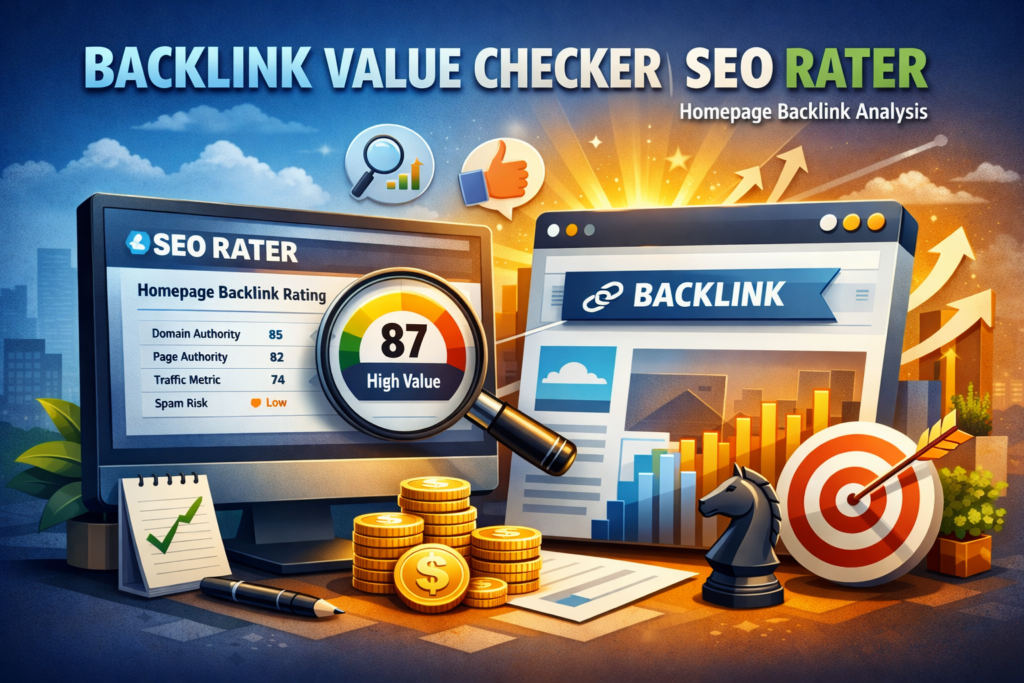
One of the first things you’ll probably interact with is the Backlink Value Checker, and it immediately sets the tone for what this platform is trying to do. It doesn’t overwhelm you with theory or long explanations before you even get to input something. You just start. You drop in a URL or context, and it gives you a structured estimation of backlink value based on aggregated SEO signals. It’s not pretending to be Google’s internal algorithm—it’s more like a practical interpretation layer that tries to translate messy SEO signals into something you can actually act on. 🔍
The overall platform, SEO Rater, sits on that same philosophy: simplify without completely dumbing things down. And that balance is harder than it sounds. A lot of SEO tools either go too technical, where only specialists care, or too shallow, where everything is “good / bad / medium” with no real meaning behind it. SEO Rater tries to stay in the middle. It aggregates known ranking signals and compresses them into a rating system that feels less like a mystery score and more like a working estimate you can argue with—but still use. ⚖️
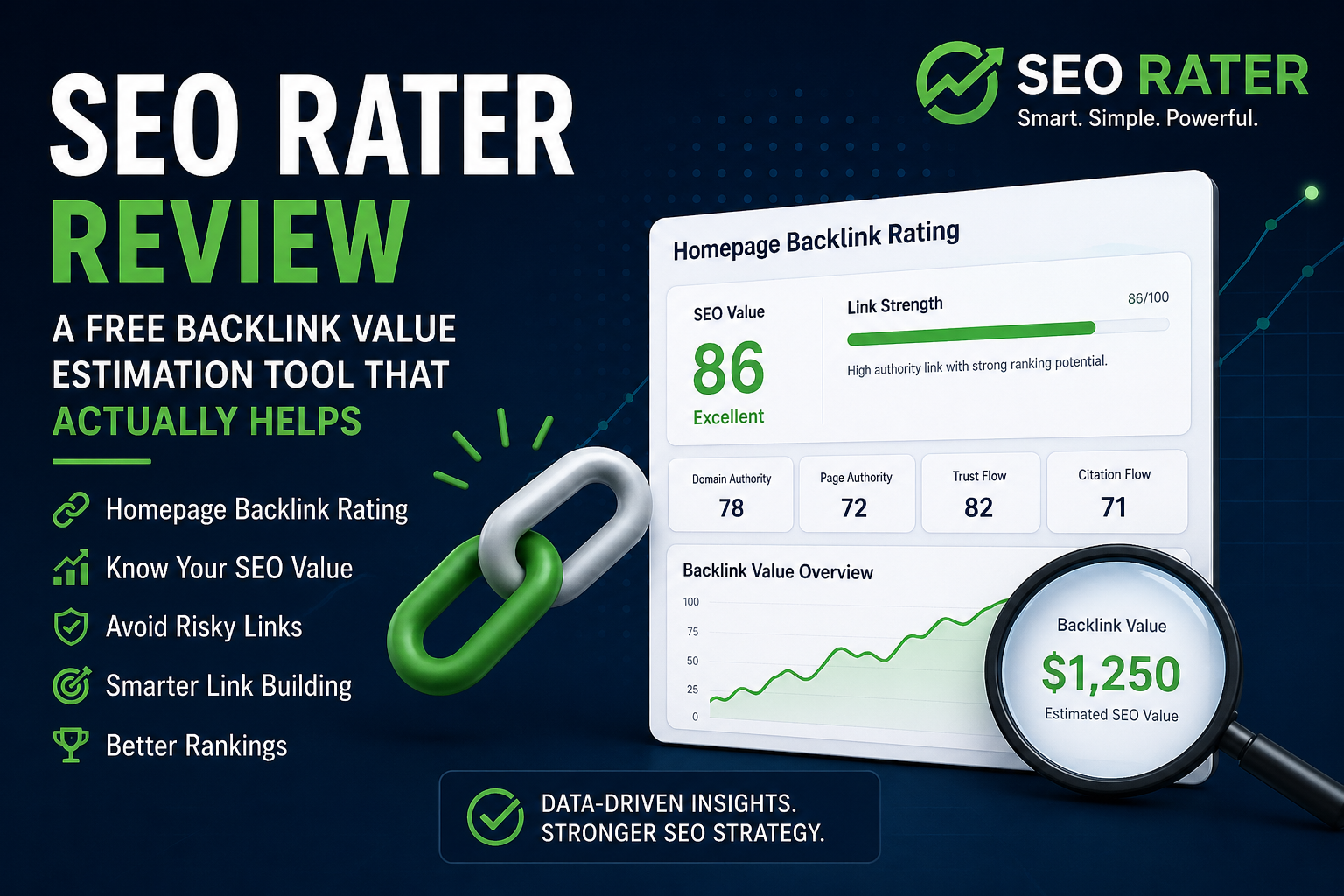
What stood out to me early on is how the tool treats homepage backlinks specifically. That’s not random—homepage links are often overvalued in hype but undervalued in strategy. In reality, they can carry disproportionate authority depending on the site structure, internal linking, and how “alive” the homepage is in terms of updates and traffic. SEO Rater doesn’t just say “high value” or “low value.” It tries to contextualize it in a way that makes you think twice before buying or placing a link just because the domain looks strong on paper. 🧠
There’s a subtle but important shift here: instead of asking “Is this domain good?”, you start asking “What does a link from this specific page actually do for me?” That change in thinking is where tools like this become useful. Because in real SEO work, you don’t rank websites—you rank pages. And not all pages inside strong domains are equal. A homepage backlink might carry weight, but if the site is bloated, inactive, or poorly structured, that weight can be misleading. 📉
Where the platform becomes more interesting is in how it attempts to standardize comparison. Anyone who has ever tried to evaluate multiple link opportunities knows how messy it gets. One site has strong traffic but weak authority signals. Another has decent metrics but questionable relevance. Another looks clean but has no organic footprint. SEO Rater tries to compress those contradictions into a single reference point so you’re not mentally juggling ten SEO tools at once. 🧩
Still, I wouldn’t call it a replacement for deeper analysis tools. It doesn’t pretend to replace manual judgment, and honestly, that’s a good thing. If anything, it works best as a second opinion. You still need to look at context: niche relevance, content quality, link placement type, and whether the backlink feels natural or forced. No scoring system can fully capture that. But what SEO Rater does is reduce the chance that you completely miss something obvious—like overpaying for a link that looks powerful but behaves weakly in practice. ⚙️
One of the more practical use cases I found is during negotiation. If you’re talking to a site owner about placing a homepage backlink, having a rough “value estimate” changes the conversation. Instead of arguing abstractly about “authority,” you can reference a structured metric and ask why the price or exchange value is what it is. It doesn’t guarantee a better deal, but it shifts the discussion from emotional to analytical, which is already a win in link building. 💬
Another thing worth mentioning is how it behaves as a tracking mindset tool. Even if you don’t rely on it for every decision, using it consistently builds a kind of internal benchmark. You start remembering what a “high-value homepage link” looks like in practice according to the tool, and that influences how you evaluate future opportunities—even outside the platform. That’s a subtle but real effect: it trains your judgment over time. 📊
Of course, no tool in SEO exists without limitations, and SEO Rater is no exception. Any system that compresses multiple ranking signals into a single score is always going to simplify reality. Sometimes too much. There are cases where context matters more than aggregated metrics, especially in niche industries or local SEO scenarios where authority signals behave differently. So if you treat it as absolute truth, you’ll eventually make wrong calls. But if you treat it as directional guidance, it holds up surprisingly well. ⚠️
What I appreciate most is that it doesn’t feel like it’s trying to replace thinking. It feels more like it’s trying to reduce uncertainty. That might sound like a small difference, but in SEO work, uncertainty is usually the most expensive part of the process. You don’t lose money because you don’t have data—you lose it because you don’t trust the data you already have. Tools like this try to tighten that gap, even if imperfectly. 🧩
From a broader perspective, SEO Rater sits in an interesting category of tools that don’t try to be everything. It’s not a full SEO suite, not a keyword platform, not a content optimizer. It’s focused on one thing: helping you estimate backlink value in a way that feels usable in real decision-making. That focus is probably its biggest strength. In a space full of bloated platforms, narrow tools often end up being more valuable than “all-in-one” solutions. 🧭
If I had to summarize my experience with it in a simple way, I’d say this: it’s not the tool you use to discover SEO. It’s the tool you use to sanity-check it. It won’t replace your strategy, but it can quietly improve it by filtering out bad assumptions before they turn into expensive mistakes. And in link building, avoiding bad decisions is often just as important as finding good ones.